Working title: Emoji Drawing as Shared Symbolic Composition
A browser-based interactive drawing tool that uses emoji as visual units instead of normal lines or brushes.
Purpose
This project aims to build an interactive web page that allows users to make drawings with emoji instead of using normal lines or brushes. On this page, the system will randomly generate emoji, and the user can place them in different positions to create an image. The user can also change the size of the emoji, rotate them, and mirror them, so the final composition is not only random but also shaped by the user’s own choices.
The main idea comes from Xu Bing’s Book from the Ground. In that project, he used visual symbols to build a communication system that can be understood without depending too much on one specific spoken language. I think this idea is very inspiring for my project because emoji already work like a kind of shared visual language on the internet. People from different countries may have different first languages, but they can still understand many emoji in a similar way. Because of this, I want to use emoji not only as symbols for chatting, but also as the material for image-making.
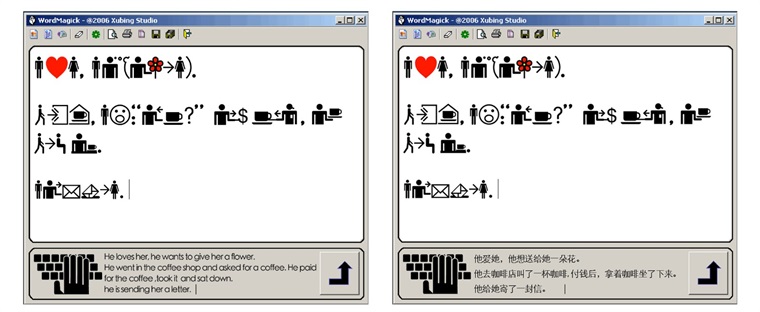
The purpose of my project is to let users cross over the traditional barrier of drawing skill. In many drawing tools, users need to know how to control lines, colour, or composition from the beginning. My project tries to reduce this pressure. Instead of drawing from nothing, the user starts with ready-made visual symbols. Then the creative process becomes one of choosing, arranging, repeating, transforming, and combining. I think this can make digital drawing feel more open and playful.
At the same time, I also want the project to question what “drawing” means. The image is produced by the relationship between many small existing signs. This makes the project both interactive and conceptual. It is interactive because the user can directly manipulate the emoji on screen. It is conceptual because it asks whether a picture can be built from a common symbolic language rather than from traditional drawing methods.
Worth
I think this project is worth developing because it offers a more accessible and experimental way to create images. One important value of the project is that it lowers the threshold for participation. Users do not need strong drawing ability to make something visually interesting. They only need to respond to the random emoji, decide where to place them, and adjust their appearance. This means the project can invite people who may not usually use drawing tools. In this sense, the project supports a more inclusive idea of creativity.
Another reason the project is worth making is that it turns emoji into a new artistic material. In everyday life, emoji are mostly used in messaging or social media to show emotion, reaction, or simple information. They are usually part of writing, not part of image composition. My project changes this situation by treating emoji as visual objects. Once the emoji can be moved, enlarged, rotated, or mirrored, they stop being only language support and start becoming part of a drawing system. I think this shift is interesting because it moves emoji from communication into composition.
The project is also valuable because of the role of randomness. Since the emoji are generated randomly, the user does not have complete control at the beginning. This creates a small challenge. The user needs to react to what the system gives and find a way to build an image from it. I think this relationship between control and surprise is important. It makes the experience more playful, but it also encourages creative thinking. Instead of only expressing a fixed plan, the user collaborates with the system. The final work becomes a result of both intention and chance.
In addition, the project has worth because it is suitable for a browser-based creative tool. It does not need to be as complicated as professional software. Its value comes from having one clear interaction idea and developing it in a focused way. A small web tool can still be meaningful if its concept is clear and its interaction is enjoyable. For this project, the simple feature set is actually part of the strength.
Framing
I frame this project as a small interactive expressive tool rather than a professional design platform. Its purpose is not to produce highly polished illustration work, but to explore a specific form of interaction: composing images with emoji through direct manipulation. Because of this, the project should remain limited and focused. The main interaction loop is simple: the system generates an emoji, the user places it on the page, then the user can transform it by scaling, rotating, or mirroring it. After that, the process repeats and the composition slowly grows.
This framing is important because it helps define the project clearly. If I try to make it too complex, it may lose its main idea. The project does not need brushes, colour pickers, or many editing panels. What it needs is a clear and enjoyable way for users to interact with emoji as visual units. So I want the interface to stay simple and direct. The page should be easy to understand at the beginning, even for first-time users. At the same time, it should still allow interesting results through repetition and arrangement.
I also frame the project through the idea of constraint. The user has freedom, but this freedom is limited by the system. They cannot draw anything in any way. They must work with the emoji that appear and use transformation tools to organise them. I think this balance between freedom and limitation is one of the most interesting parts of the project. It can make the process more creative because the user needs to adapt to the system instead of only controlling it.
Another important part of the framing is that the project is web-native. It is designed for HTML, CSS, and JavaScript in the browser, not for a complex external software environment. This is meaningful because emoji themselves belong strongly to digital communication culture. They come from phones, interfaces, chats, and online platforms. So using them in a browser-based tool keeps the project close to their original context.
Interactive experiments
Instead of only writing about references, I translated them into four small interaction studies. Each experiment tests one simple mechanism that can support my final emoji drawing project.
Experiment 1: Fixed grid placement (from Broider)
This small test uses a 3×3 grid and lets the user place emoji inside each square.
This connects to Broider because both use fixed positions to build a visual composition.
Experiment 2: Rotated placement (from OrbiDraw)
This experiment lets the user rotate an emoji first, then place it into a small stage area.
This connects to OrbiDraw because it explores how direction and rotation can change the placed form.
Experiment 3: Random emoji generation
This experiment tests a simple random generator that can later support the main drawing tool.
This can support the final project by letting the system provide visual material before the user starts composing.
Experiment 4: Scale control
This experiment tests a simple slider that lets the user enlarge or reduce one emoji before placement.
This can support the final project by helping one emoji work as either a small detail or a larger visual focus.
Reference links
- Xu Bing, Book from the Ground: Official page
- Broider: Open tool
- OrbiDraw: Open tool